Oops! Something went wrong while submitting the form.
Contact
Want to connect or talk about a partnership? We’d love to hear from you.
Cultivated Fats & Oils
Our cultivated fats and oils, derived from single-cell organisms like yeast, represent a breakthrough in sustainable lipid production.
Our cultivated fats and oils, derived from single-cell organisms like yeast, represent a breakthrough in sustainable lipid production Customizable profiles Can produce oils with specific fatty acid compositions tailored to various applications Sustainability Cutting carbon footprint and resource use while preserving rainforest biodiversity Localsupply chain Year-round production unaffected by seasons or climate change and scalable globally Traceable and originally pure Biomanufacturing uses lean processes and specific feedstocks, producing impurity-free products Unique fatty acids Ability to produce oils with rare and valuable fatty acids not easily obtained from plant sources Our cultivated fats and oils continue to pave the way for a more sustainable and versatile future in lipid production for food, cosmetics, and pharmaceuticals
Protein Engineering, Fermentation Technology, & AI Application
We leverage our expertise in protein engineering, fermentation technology, and AI-driven discovery to unlock new possibilities. Our goal is to address global challenges and improve lives across the planet.
Our cultivated solutions have practical use cases across multiple sectors
We leverage our expertise in protein engineering, fermentation technology, and AI-driven discovery to unlock new possibilities. Our goal is to address global challenges and improve lives across the planet.
Advancing Ingredients for Food, Cosmetics, & Pharmaceuticals
Advancing ingredients for food, cosmetics, and pharmaceuticals. Discover how we produce SMEY Oils
Advancing ingredients for food, cosmetics, and pharmaceuticals
Discover how we produce SMEY Oils
Our approach centers on smart screening to identify the best yeast strains for high-titer, scalable production. We also use proprietary machine learning algorithms for strain development through metabolic engineering.
How we produce cultivated oils
We’ve introduced innovation to oil and fat production. It begins with the discovery and isolation of unique yeast strains, which we identify through careful screening and selection. Afterwards, these specialized yeasts are cultivated under optimized conditions. This allows them to accumulate high levels of valuable oils and fats.
The benefits of our production methods compared to traditional technologies
Non-animal sourced, no deforestation involved
Low and controlled impurities
Locally produced with low environmental impact
Up to 90% less carbon footprint
Plant free
Our proprietary AI technology based on machine learning revolutionizes oil production from yeast by scanning databases to identify and analyze yeast strains with high oil production. It predicts oil types and yields and guids us in creating new strains with tailored oils. This accelerates development and advances sustainable oil production.
Combining AI & Biotechnology
We are a Techbio company that combines AI and biotechnology to create sustainable, impactful innovations that push the boundaries of traditional biotech
We are a Techbio company that combines AI and biotechnology to create sustainable, impactful innovations that push the boundaries of traditional biotech
A name was born
Our name is derived from Alexander NESMEYANOV, a pioneering 20th-century organic chemist. He played a key role in the Sputnik project and innovated synthetic food production in the 1960s, focusing on yeast fermentation and plant-based proteins to create animal products without harming animals. His drive to improve the world was matched by his exceptional talent and scientific skill.
Human well-being
Our innovative ingredients enhance consumer products, contributing to a higher quality of life.
Technology leadership
We prioritize early-stage, comprehensive R&D to ensure we develop the best products from the outset.
Win-win cooperation
We value transparency, synergy, and enthusiasm in our B2B partnerships, leading to mutual success.
Sustainability
Our approach focuses on creating valuable products more efficiently and sustainably, without disrupting nature.
We have pioneered advanced biotechnologies that bring essential innovations to the food, cosmetics, and pharmaceuticals industries, benefiting both consumers and producers
Our lab
Fueled by dedication and cutting-edge biotechnology, our next-generation products are crafted in our advanced lab in Germany, where our skilled scientists ensure the highest safety standards through bi-annual independent audits. Our team specializes in biotechnology, chemistry, and food science, with extensive experience in scaling innovative products.
We integrate in-house R&D with strategic partners, utilizing open innovation and specialized expertise. Our lab also generates vital data for AI models that identify promising yeast species for production and validate our predictions, driving continuous improvement in our offerings.
We combine data science, bioinformatics, biochemistry, microbiology, and process engineering to advance multiple industries. Want to join us?
A Techbio Company
At SMEY, we are revolutionizing the use of rare ingredients through cutting-edge biotechnology, advancing global health and sustainability.
Cultivating Oils
Harnessing the power of our Neobank of 1,000 yeasts, we leverage AI and biotechnology to revolutionize cosmetics and food with unique, high-performance oils.
NOY™
Neobank of Yeasts (NOY) is the first digital databank of yeasts providing access to new unique oils. It combines oil and genomic data for 1000 yeast species.
SMEY.AI
SMEY.AI models use NOY data training to predict oil content and profile for any yeast, as well as “oily” genetic features.
Our oils are always locally cultivated. Using AI-powered strain selection, we ensure high oil production from Neobank to the factory.
First Digital Neobank of Yeasts (NOY)
SMEY has access to a diverse collection of 100+ exclusive microbial oils and fats, thanks to our pioneering digital Neobank of Yeasts. This ensures optimal, ready-to-use production technology for our clients.
SMEY.AI
At SMEY, our in-house Machine Learning optimized process and high-performance strains deliver high product yields: 15 g/L for bioactive proteins, 50g/L for nutritional proteins, and 75 g/L for cultivated oils.
SMEY Factories
SMEY specializes in process industrialization, achieving standard industrial-scale production capacities of 1,000 metric tons of oils per year for cosmetics and 10,000metric tons per year for confectionery.
Consumer issues we're addressing
Noyl Silk™ - cultivated High-Oleic Oil (cHOO)
Noyl Silk™ - cultivated High-Oleic Oil (cHOO)
Noyl Silk for sensorial excellence, stability, active performance, and sustainability, all at once.
FOR SKIN: Soothing dry, chapped skin, reducing redness, and maintaining hydration.
FOR HAIR: Emollient oil for dry, damaged, and fragile hair, also great for scalp health.
FOR LIPS: Ingredient for lip balms, lipsticks, and other lip care products.
cHOO is a good source of extra pure oleic acid.
Fats & Oils / Cosmetics
Noyl Cocoa - Cultivated Cocoa Butter (cCB)
Noyl Cocoa - Cultivated Cocoa Butter (cCB)
A complete analog of cocoa butter, produced from a non-tropical source with a low environmental impact.
FUNCTION:
This sustainable cocoa butter equivalent is an essential ingredient for chocolate and cocoa-based products. It enhances texture, mouthfeel, stability, and overall quality, all while maintaining a neutral flavor profile.
APPLICATIONS IN FOOD & BEVERAGES:
cCB serves as an excellent alternative to traditional CBEs from tropical sources, suitable for a wide range of applications, including chocolate, confectionery, and cocoa-based products such as fillings and glazes.
Fats & Oils / Food
Skincare
Skincare
Explore our range of ingredients designed to nourish, protect, and rejuvenate the skin. Ideal for creams, serums, and other skincare formulations.
APPLICATIONS:
- Hydration and moisturization
- Anti-aging and collagen support
- Acne treatment and oil control
- Skin barrier repair and UV protection
PRODUCTS:
- Ultra-pure Oleic Acid (95-96%)
- Cultivated High Oleic Butter (cHOB) (High C18:1 Content, Low C18:2, no C18:3)
cHPO - our Cultivated High Palmitic Oil is a 90% bioidentical, non-tropical alternative to traditional palm oil with a low environmental impact. It can be used to enhance stability and provide a smooth texture in sauces, as well as to ensure shelf stability without refrigeration.
Glyceryl monooleate is a polar lipid that swells in water to give several phases with different rheological properties. It is used in topical formulations as an emollient and as an emulsifying agent for water-in-oil emulsions. It is also a stabilizer for oil-in-water emulsions. Glyceryl monooleate gels in excess water, forming a highly ordered cubic phase that can be used to sustain the release of various water-soluble drugs. It is also the basis of mucoadhesive drug delivery systems. Glyceryl monooleate is reported to enhance transdermal and buccal penetration and it has been investigated in inhalation delivery systems. Glyceryl monooleate has been investigated for the encapsulation of drugs in liquid crystalline nanoparticles for the entrapment of drugs for oral and ocular delivery.
Fats & Oils / Pharmaceutical
Haircare
Haircare
Our ingredients support healthy hair and scalp while repairing damage. Ideal for shampoos, conditioners, and hair oils.
APPLICATIONS:
Repairing damaged and fragile hair
Scalp hydration and care
Strengthening and anti-frizz
PRODUCTS:
Cultivated High Oleic Butter (cHOB) (High C18:1 Content, Low C18:2, no C18:3)
Argan Oil (Fatty Acid Profile of Argan Oil)
Camellia Oil (Fatty Acid Profile of Camellia Oil)
Avocado Oil (Fatty Acid Profile of Avocado Oil)
Applications / Cosmetics
Noyl Cocoa™ - cultivated Cocoa Butter (cCB)
Noyl Cocoa™ - cultivated Cocoa Butter (cCB)
Noyl Cocoa is a perfect solution when you'd like to substitute unsustainable cocoa butter equivalents in your formulations with CBEs produced from non-tropical sources.
Cocoa butter and its equivalents are used in several applications.
MOISTURIZERS: Widely used in skin products due to its excellent emollient properties, helping to hydrate and nourish the skin.
LIP BALMS: Its edible nature and moisturizing qualities make cocoa butter a common ingredient in lip care products, providing hydration and protection against chapping.
BODY BUTTERS: often combined with other oils and butters, cocoa butter is used in body butters for deep moisturization and to improve skin texture.
Fats & Oils / Cosmetics
Noyl Avocado
Noyl Avocado (Fatty Acid Profile of Avocado Oil)
An avocado oil extender with a fatty acid composition and physical characteristics similar to original avocado oil.
FUNCTION:
A rich source of healthy monounsaturated fatty acids, including Omega-7 Palmitoleic acid, and offers a high smoke point for versatile culinary use.
APPLICATIONS IN FOOD & BEVERAGES:
Provides the same fatty acid profile and physical properties as original avocado oil, making it ideal for producing more affordable cooking and dressing oil blends. It can also be used in products that incorporate avocado oil.
Fats & Oils / Food
Lip care
Lip Care
Enhance the hydration and protection of lips with our versatile ingredients, perfect for balms, lipsticks, and glosses.
APPLICATIONS:
Lip balms for hydration and repair
Lipsticks with smooth application and nourishment
PRODUCTS:
Cultivated High Oleic Butter (cHOB) (High C18:1 Content, Low C18:2, no C18:3)
Avocado Oil (Fatty Acid Profile of Avocado Oil)
Cultivated High Palmitic Oil (cHPO)
Cultivated Cocoa Butter Equivalent (cCBE)
Applications / Cosmetics
Confectionary
Confectionary
cCBE - an alternative CBE from non-tropical and sustainable sources that reduces the cost of recipes while providing the same performance as cocoa butter.
Applications / Food & Beverages
Noyl Palm™
Noyl Palm - cultivated High Palmitic Oil (cHPO)
Our Noyl Palm (cHPO) is a perfect sustainable and EUDR compliant solution for direct applications in lipsticks, makeup, and other direct applications without any unpleasant odor and with a neutral creamy color.
At the same time, the palm-free alternative is a robust building block for more than 200 downstream product derivatives of palm oil, including acids, alcohols, esters, and hydrogenated products.
Fats & Oils / Cosmetics
Noyl Omega-7™
More information coming soon.
Fats & Oils / Cosmetics
Body care
Body Care
Moisturize and soothe the body with sustainable and effective ingredients for lotions, butters, and creams.
APPLICATIONS:
Deep hydration for dry and sensitive skin
Stretch mark and scar care
Soothing irritation and redness
PRODUCTS:
Cultivated Cocoa Butter Equivalent (cCBE)
Camellia Oil (Fatty Acid Profile of Camellia Oil)
Avocado Oil (Fatty Acid Profile of Avocado Oil)
Ultra-pure Oleic Acid (95-96%)
Argan Oil (Fatty Acid Profile of Argan Oil)
Cultivated High Palmitic Oil (cHPO)
Applications / Cosmetics
Dietary Products
Dietary Products
cHPO - our Cultivated High Palmitic Oil is a 90% bioidentical, non-tropical alternative to traditional palm oil with a low environmental impact. Thanks to its versatility, neutral taste, and texture-enhancing properties, it can replace widely used palm oil and serve as an eco-conscious solution in dietary products.
Applications / Food & Beverages
Sustainable Cosmetics
Sustainable Cosmetics
Formulate sustainably with our eco-friendly and EUDR-compliant alternatives, designed to reduce environmental impact.
APPLICATIONS:
Palm-free alternatives
Cocoa butter equivalents from non-tropical sources
cHPO - our Cultivated High Palmitic Oil is a 90% bioidentical, non-tropical alternative to traditional palm oil with a low environmental impact. Its unique properties make it a sustainable substitute for palm oil in baked goods, offering eco-conscious food solutions.
Applications / Food & Beverages
Functional and sports nutrition
Functional and Sports Nutrition
Information coming soon.
Applications / Food & Beverages
Supplements and Nutritional Care
Supplements and Nutritional Care
Our products go beyond cosmetics, offering nutritional benefits for skin health and overall well-being.
Higher intakes of odd-carbon fatty acids, such as C15:0, have been linked to lower mortality in some studies by reducing the risk of cardiovascular disease and type 2 diabetes, as it may help lower total cholesterol and glucose levels while improving insulin sensitivity. Some studies also suggest a lower risk of certain cancers with higher C15:0 levels. Pentadecylic acid is thought to help improve liver health biomarkers such as lower alanine aminotransferase (ALT) and aspartate aminotransferase (AST) levels, which have been linked to a lower risk of non-alcoholic fatty liver disease and non-alcoholic steatohepatitis. Pentadecylic acid has potential longevity benefits: it activates AMPK and inhibits mTOR, which are key components of human longevity pathways. It also shares some activities with known lifespan-extending compounds such as rapamycin. At the cellular level, C15:0 may help strengthen cells and restore mitochondrial function.
Fats & Oils / Food Supplements
Multipurpose Oils
Multipurpose Oils
Experience the versatility of our oils, suited for a range of applications across skincare, haircare, and cleansing products.
APPLICATIONS:
Facial oils and serums
Cleansing oils
Hair and body treatments
PRODUCTS:
MCT Oil (Oil with Middle Chain C8 and C10 Triglycerides)
Argan Oil (Fatty Acid Profile of Argan Oil)
Camellia Oil (Fatty Acid Profile of Camellia Oil)
Avocado Oil (Fatty Acid Profile of Avocado Oil)
Applications / Cosmetics
Baked Goods
Baked Goods
cHPO - our Cultivated High Palmitic Oil is a 90% bioidentical, non-tropical alternative to traditional palm oil with a low environmental impact. Its unique properties make it a sustainable substitute for palm oil in baked goods, offering eco-conscious food solutions.
Heptadecanoic acid is naturally present in full-fat dairy and some meats, but modern dietary trends (e.g., low-fat diets) may lead to lower consumption. Supplements help reintroduce this potentially beneficial fatty acid. Higher levels of C17:0 are associated with lower risks of cardiometabolic diseases, including type 2 diabetes. It may help improve insulin sensitivity and glucose metabolism. In some studies C17:0 supplementation has been linked to reduced inflammation and it may help lower triglyceride levels, which is a key factor in atherosclerosis (plaque buildup in arteries). Emerging research suggests saturated fatty acids like heptadecanoic acid may play roles in brain health, possibly by supporting the integrity of cell membranes in neurons.
Heptadecanoic acid supplementation might help in treating or preventing nonalcoholic fatty liver disease. It may help in treating hyperferritinemia (excess iron storage) without requiring phlebotomy. Heptadecanoic acid has been shown to possess antimicrobial.
Fats & Oils / Food Supplements
Cooking and Dressing Oils
Cooking and Dressing Oils
AVOCADO OIL - is a solution to produce oil mixtures for cooking and dressings with a very healthy fatty acid profile similar to avocado oil, enriched with monounsaturated lipids and which has a high smoke point.
Applications / Food & Beverages
Noyl Camellia™
Noyl Camellia™ (Fatty Acid Profile of Camellia Oil)
Camellia oil is widely used in cosmetics for a few key reasons: It deeply hydrates the skin and helps maintain moisture due to its high oleic acid content.
The oil is quickly absorbed and does not leave a greasy residue. In addition, camellia oil stimulates collagen production, helping to reduce wrinkles and fine lines.
It contains antioxidants that protect the skin from free radical damage.
It can be used in hair, face, and body care, making it a multi-purpose ingredient.
Camellia oil can help treat and soothe skin irritations by minimizing redness and inflammation, and can also help reduce dark spots and improve skin texture and tone.
It does not clog pores, making it suitable for all skin types, including oily and acne-prone skin.
Due to these properties, camellia oil has become a popular ingredient in a variety of cosmetic products, from serums and creams to hair care, in both high-end and niche brands.
Fats & Oils / Cosmetics
Plant-based Products
Plant-based Products
MCT OIL - a good solution for fortification of plant-based food, especially butter spreads, with a quick energy source from healthy fats.
Applications / Food & Beverages
Plant-based alternatives
Plant Based Alternatives
Information coming soon.
Applications / Food & Beverages
Special Oils Designed by Customer Requirements
Fats & Oils / Cosmetics
Sauces and seasonings
Sauces and Seasonings
Information coming soon.
Applications / Food & Beverages
No results found
Please try different keywords.
April 15, 2026
From Fields to Fermentation: Higher Yield, Better Performance, Smarter LCA
Andrei Slipchenko
Director of Regulatory and IP Strategy
For decades, the personal care and cosmetics industry has operated on a simple, a bit fragile, paradigm: formulate with botanical oils, rely on tropical agricultural supply chains, and market the "natural" origin to consumers. Today, that paradigm is fracturing.
Industrial buyers and beauty formulators are under regulatory pressure, climate-induced crop volatility, and increasingly scrutinized sustainability metrics. Yeast-derived fermented oils are emerging as the frontrunners.
We must look at the hard data, efficacy and high functionality, stability, the true Life Cycle Assessment (LCA) numbers, and the techno-economic realities of shifting from agricultural fields to bioreactors.
The Baseline: Traditional Botanical Lipids
When we analyze standard Life Cycle Inventory (LCI) databases like Ecoinvent alongside specific agricultural LCAs, the environmental burden of traditional cosmetic lipids becomes a stark mathematical reality.
Cosmetic formulations frequently rely on rich butters and specialty oils (e.g., cocoa, shea, and argan) to deliver barrier repair and desirable sensory properties. However, these ingredients carry significant environmental burdens.
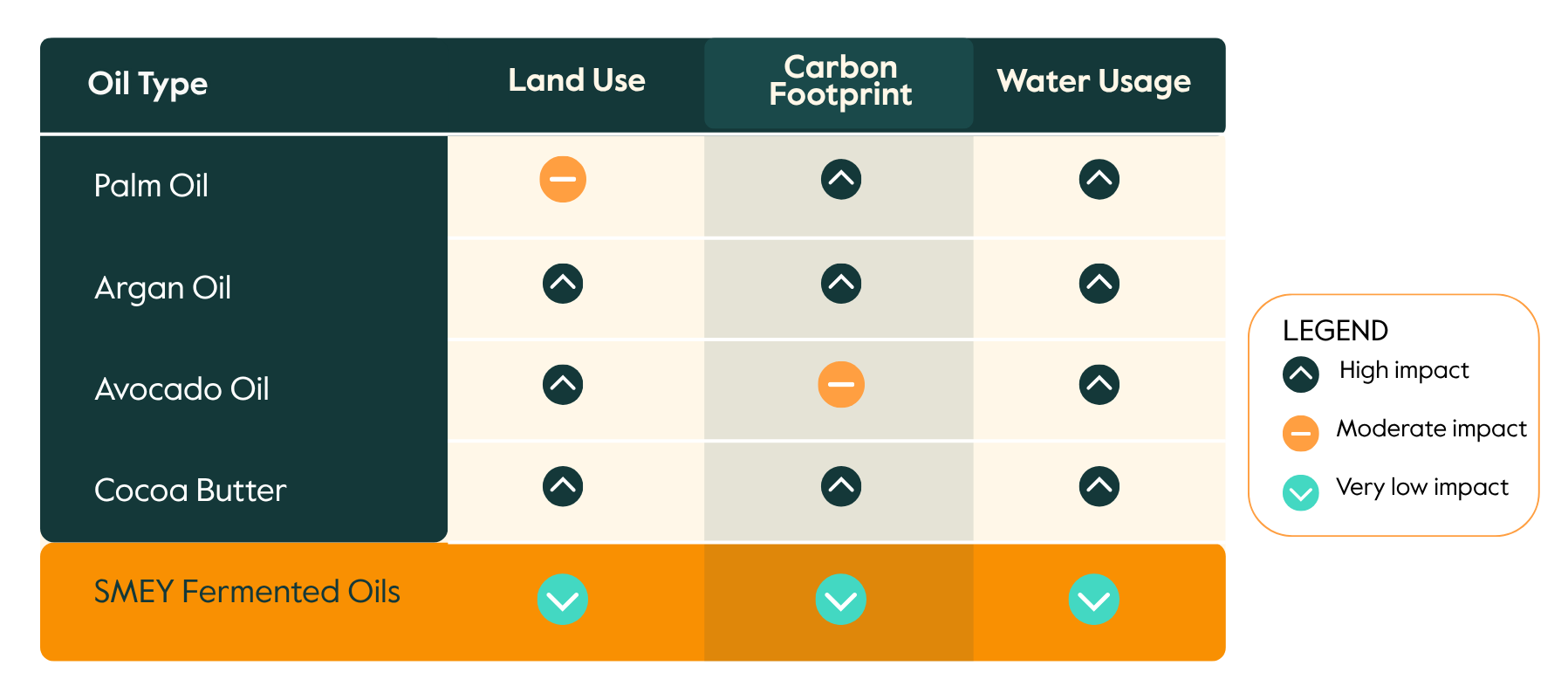
High land use requirements: These crops are land-intensive, with cocoa requiring ~14–20 m²·year/kg, while shea and argan can reach 50–100 and 140–180 m²·year/kg, respectively.
Significant water consumption: The water footprint is equally substantial, with 12,000–16,000 liters of water required to produce 1 kg of cocoa or argan butter (cradle-to-gate).
Limitations of RSPO-certified alternatives: While the industry has increasingly shifted toward RSPO-certified palm oil derivatives as a more sustainable alternative, current supply volumes are insufficient to meet global demand.
With extreme weather events increasing the volatility of crop yields, relying on these extended, opaque agricultural supply chains is no longer just an environmental liability; it is a profound business risk.
The Honest LCA of Fermented Oils
To position precision fermentation as a viable industrial alternative, we must be intellectually honest about its own LCA. Fermented oils are not "landless" or "emissions-free."
Yeast-derived oils require a carbon source — typically agricultural sugars — to feed the fermentation process. Furthermore, heterotrophic yeast strains require continuous aeration, agitation, and precise temperature control inside massive stainless-steel bioreactors.
Early academic LCA models evaluated unoptimized, pilot-scale fermented oil production and found the Global Warming Potential (GWP) hovering between 7.2 and 11.6 kg CO₂-eq/kg.
In an unoptimized state powered by standard fossil-heavy electrical grids, the energy demand of a bioreactor can push the carbon footprint of a biotech oil higher than that of efficiently farmed, highly refined traditional vegetable oils.
At SMEY, our techno-economic models are built around surpassing the baseline inefficiencies of early precision fermentation. Through our proprietary Neobank of Yeasts (NOY™)— a database of over 1,000 non-GMO, naturally biodiverse yeast strains—and SMEY.AI, we screen for strains that naturally exhibit hyper-accumulation of targeted lipids.
This allows us to achieve an advanced industrial yield of 25%. In practical terms, a 4:1 mass conversion ratio: it takes exactly 4 kg of sugar substrate to produce 1 kg of purified oil.
Plant based and animal based alternatives underperform or are not ethical and sustainable
Currently, using first-generation commercial glucose and standard grid parameters, the Product Carbon Footprint (PCF) of our flagship fermented oil, Noyl Silk, stands at a highly competitive 6.7 kg CO₂/kg.
This is just the beginning because precision fermentation is not a static agricultural process; it is an optimizable technology. Achieving "elite" low-carbon status — dropping the PCF down to the 2.0 – 3.5 kg CO₂-eq/kg range — requires aggressive, systematic interventions.
Formulation Pragmatism: Quality Control Beyond Carbon
For cosmetic formulators, performance and consistency are critical. Traditional plant-based oils often vary due to environmental factors and may contain contaminants, affecting stability. In contrast, precision fermentation produces oils in controlled conditions, ensuring high purity, complete batch-to-batch consistency, and improved oxidative stability — resulting in more reliable formulations and longer shelf life without heavy antioxidant use.
The transition from botanical oils to fermented lipids is not just a sustainability initiative; it is a necessary evolution in supply chain engineering.
By utilizing discovery platforms like Lipid Atlas we are providing the beauty industry with a localized, ethical, and mathematically verifiable alternative to high-risk agricultural commodities. Noyl Silk™ proves that formulators no longer have to compromise between sensorial excellence, rigorous quality control, and an elite Life Cycle Assessment.
The future of cosmetic formulation relies on data, predictability, and biological precision. The field has reached its limits; the bioreactor is where the industry scales next.